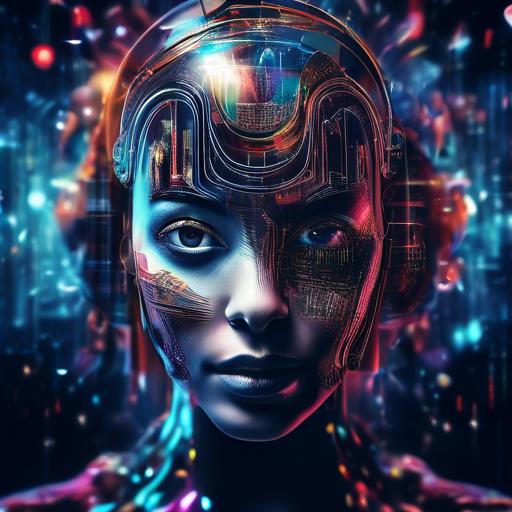
In the early dawn of the 21st century, an ethereal brush began to paint the canvas of our digital world with strokes of ones and zeros. This brush, wielded by the hand of artificial intelligence, is transforming the visual media industries in ways that once seemed the stuff of science fiction. Imagine a universe where artists collaborate with algorithms, filmmakers conjure lifelike worlds with a few clicks, and storytellers spin narratives that respond in real-time to their audiences. As we stand on the precipice of this brave new world, it’s time to explore how AI is not just disrupting, but enriching and expanding the horizons of visual media. Come along as we delve into a tale of innovation and imagination, where creativity meets technology in a dance of endless possibilities.
Unlocking Creative Potential with AI: Transforming Visual Media
Artificial Intelligence (AI) has emerged as a powerful muse for artists, designers, and content creators, revolutionizing the way visual media is conceived and rendered. With AI-driven tools, creatives are experiencing unprecedented liberation, enabling them to push the boundaries of imagination and innovation. **Generative adversarial networks (GANs)** and other sophisticated algorithms are powering a new era of digital artistry, transforming static visuals into dynamic, adaptable pieces of art.
One of the most exhilarating applications of AI in visual media is in **dynamic content creation**. Traditional methods often demand an exhaustive amount of time and effort to produce compelling graphics, animations, or visual effects. AI, however, can analyze and understand the aesthetics, style, and context, automating numerous processes. This not only accelerates production but also elevates the quality of the output. Imagine the possibilities when AI tools can render life-like animations or breathtaking special effects at a fraction of the time!
Enhanced image and video editing capabilities
Automated content curation
Realistic special effects generation
Seamless integration of CGI with live-action footage
Moreover, AI facilitates **personalized media experiences**. By leveraging AI algorithms, creators can tailor visual content to resonate with specific audiences on an individual level. This personalization isn’t limited to marketing but extends to entertainment and education, resulting in highly engaging and relatable experiences for viewers. For example, adaptive learning environments can utilize AI to craft visual aids that cater to different learning styles, enhancing educational outcomes.
Consider the potential in **content restoration and enhancement**; AI is breathing new life into old media, restoring and optimizing archival footage with remarkable precision. Classic films and photographs can be enhanced to meet modern viewing standards, preserving cultural heritage while making it accessible to future generations. This process involves techniques like **upscaling**, where AI algorithms add details to low-resolution images or videos, elevating them to stunning 4K or even 8K quality.
AI Application
Impact on Visual Media
Generative Art
Creates complex and novel artistic patterns
Image Recognition
Automates tagging and sorting of visuals
Video Editing
Speeds up the post-production process
Content Personalization
Produces tailored and engaging media experiences
From Concept to Creation: AIs Role in Streamlining Production
Artificial Intelligence (AI) has revolutionized the way production is approached in the visual media industry. One of the most transformative aspects is the **acceleration of pre-production** processes. What once took weeks or even months can now be completed in days thanks to AI-powered tools that handle script analysis, storyboard creation, and even casting suggestions. This efficiency allows creative teams to focus more on the artistic aspects of their projects, streamlining the entire workflow.
When it comes to **content generation**, AI has also proven to be invaluable. From generating impressive VFX to creating lifelike digital characters, AI algorithms have expanded the creative horizons. Filmmakers can now deploy AI-driven tools to automatically render realistic environments or even simulate complex action sequences. This not only reduces production time but also significantly cuts costs.
Another exciting use of AI in visual media production is in **post-production**. Advanced AI systems can now edit raw footage, removing unwanted elements or seamlessly integrating CGI components. This meticulous attention to detail ensures a polished final product ready for distribution. Machine learning algorithms are also employed to enhance color grading and audio engineering, ensuring that every frame and sound byte is refined to perfection.
The use of AI doesn’t stop within the studio; it extends to audience engagement and distribution strategies. AI analytics tools gather invaluable viewer data, assisting producers in tailoring content to meet audience preferences more accurately. This results in higher engagement rates and more successful marketing efforts.
AI’s role in **real-time effects and live production** cannot be understated. With the advent of real-time rendering engines powered by AI, producers can simulate lighting, weather conditions, and even actor movements live. These capabilities facilitate decision-making on the fly and open up new possibilities for innovative storytelling.
Enhancing Visual Effects: The Digital Magic of AI
In the modern landscape of visual media industries, AI’s contribution to enhancing visual effects cannot be overstated. These groundbreaking technologies have allowed creators to push the boundaries of imagination and realism in unprecedented ways. Whether it’s through the intricate details in animated films or the seamless integration of CGI in live-action movies, the potential to achieve stunning visuals has expanded exponentially.
Deep Learning Algorithms: AI can analyze vast amounts of data to enhance image and video quality, making scenes look more lifelike than ever before.
Generative Adversarial Networks (GANs): GANs can generate realistic textures and facial expressions, enabling more immersive character designs.
Automated Editing Tools: AI-powered tools can streamline the editing process, autonomously correcting color, reducing noise, and even suggesting the best cuts.
In addition to improving the visual quality, AI also optimizes production timelines and budgets. Automated processes reduce the need for time-consuming manual work, allowing studios to focus their resources on creativity and innovation. This efficiency has democratized visual effects, making high-quality VFX accessible to smaller studios and independent filmmakers.
Aspect
Traditional Methods
AI-Enhanced Methods
Rendering Time
Weeks
Days
Cost
High
Moderate
Quality
Consistent
Superb
Moreover, AI introduces new forms of augmented and virtual realities, turning once impossible scenarios into tangible experiences. For instance, real-time motion capture powered by AI enables actors to see and interact with digital environments as if they were tangible sets, creating more authentic performances and realistic interactions. This fusion of AI and real-time rendering is revolutionizing both cinema and gaming, blurring the lines between virtual and real-world experiences.
AI in Animation: Breathing Life into Characters and Worlds
Artificial Intelligence has revolutionized the animation industry, ushering in a new era where characters are no longer bound by the limitations of manual labor and human error. With AI, animators can create more nuanced and lifelike movements, seamlessly blending reality with artistic vision.
Enhanced Character Animation: AI algorithms analyze human movements to create lifelike character animations, from subtle facial expressions to complex fight choreography.
Efficient Workflow: AI-powered tools dramatically reduce the time spent on routine tasks, allowing animators to focus on creative aspects.
Cost-Effective Production: By automating repetitive tasks, studios can allocate their resources more efficiently, reducing overall production costs.
These advancements are making a significant impact not only in traditional animation but also in emerging fields like virtual reality and augmented reality. Imagine a virtual world where the inhabitants react dynamically to user input; that’s the power of artificial intelligence at play. AI algorithms can adapt the character’s responses in real-time, making the experience more immersive and engaging.
Feature
Impact
Real-time Feedback
Instantaneous character adjustments based on user actions
Dynamic Environments
Changing scenery and backgrounds powered by AI
Improved Workflow
Streamlining the animation process
Moreover, AI’s influence extends to the storytelling aspects of animation. AI tools can analyze vast amounts of data to predict audience preferences and optimize story arcs, character development, and even voice acting performances. This leads to a more personalized and resonant viewing experience, ensuring that the content not only captures attention but also leaves a lasting impression.
With these transformative capabilities, artificial intelligence is truly breathing new life into the worlds of animation, making them richer, more dynamic, and more captivating than ever before.
Perfecting the Pixel: AI-driven Post-production Mastery
In the realm of post-production, the advent of AI has transformed how creators perfect the pixel. **AI-driven tools** now enable visual artists to achieve unmatched precision and efficiency in editing. Gone are the days when hours were spent manually correcting minute details; now, AI algorithms can handle these tasks in mere seconds, enhancing the creative process significantly.
One of the standout advancements is the **automation of color grading**. Machine learning models can analyze a vast number of images, understand the desired aesthetic, and apply consistent grading across entire sequences. This ensures a coherent visual narrative and frees up directors and editors to focus on more nuanced aspects of their projects. Consider the following benefits:
Feature
Advantage
Automated Color Grading
Consistent visual aesthetics
Background Removal
Efficiency in compositing
Face Recognition
Seamless actor tracking
AI-driven noise reduction is another game-changer. Traditional noise reduction techniques often lead to a loss of detail, but with AI, the system intelligently distinguishes between noise and important image details. This results in cleaner, sharper visuals without compromising the integrity of the image.
Moreover, **AI is revolutionizing frame interpolation** – the process of generating intermediate frames between existing ones to create smoother motion in videos. This technology allows for flawless slow-motion effects and enhances the overall viewing experience, making it more immersive and engaging.
The integration of AI in post-production doesn’t just elevate quality; it democratizes the process, making high-end tools available to indie filmmakers and small studios. The future of visual storytelling is here, and it’s driven by algorithms that understand and enhance human creativity.
Barriers and Breakthroughs: Overcoming AI Limitations in Visual Media
In the ever-evolving visual media landscape, **AI-generated content** faces several significant challenges. Among the primary barriers is the **uncanny valley** effect—a phenomenon where AI-generated visuals that are almost, but not entirely, human-like elicit uncanny, unsettling feelings. Despite numerous advancements, machines still struggle to replicate the subtle nuances and the authentic emotions of human artistry.
Moreover, **issue of bias** continues to persist. AI systems, trained on datasets that encompass current societal biases, tend to perpetuate those same prejudices. This has serious implications for media accuracy and representation, necessitating innovative approaches to ensure fair and balanced content generation. Collaboration between diversely skilled teams is critical in identifying these biases and rectifying them in the system’s backend.
On the breakthrough side, advancements in Generative Adversarial Networks (GANs) have been revolutionary. GANs, where two neural networks contest with each other to produce increasingly accurate outputs, have drastically improved the quality of AI-driven visual arts. **Real-time image alteration** and **sophisticated content creation** are no longer just theoretical concepts but practical tools enhancing the craft of visual storytelling.
Another significant breakthrough is the development of **AI-driven collaboration tools**. These tools enable artists and designers to work alongside AI, blending human creativity with machine precision. This symbiotic relationship results in profoundly original works that push the boundaries of what’s possible in visual media.
Furthermore, **machine learning models** are becoming increasingly adept at understanding context, making it possible to tailor visuals more effectively to target audiences. As these technologies advance, they offer promising avenues to overcome existing limitations, continually reshaping the horizon of visual media.
Ethical Considerations: Navigating AIs Influence on Media Authenticity
As artificial intelligence continues to shape and redefine the visual media landscape, ethical considerations surrounding the authenticity of media content have become increasingly paramount. **Content creators**, **consumers**, and **regulators** all find themselves navigating an intricate web of AI-generated imagery, animation, and journalism. The stakes are high; the manner in which these technologies are utilized could either foster innovation and inclusivity or devolve into a miasma of misinformation and deceit.
A key concern lies in the realm of **image and video manipulation**. AI enables the creation of hyper-realistic visual content that can be indistinguishable from genuine footage. While this opens up incredible creative possibilities, such as revitalizing old movies or creating imaginative new worlds, it also poses a risk—**deepfakes** and **synthetic media** can be weaponized for misinformation. Ethical use guidelines and transparency are essential to maintain trust in the media we consume.
Consider these ethical principles for responsible AI use in visual media:
Transparency: Always disclose when an image or video has been AI-generated or significantly altered.
Accountability: Creators should be held responsible for the content they produce and share.
Fair Representation: Avoid perpetuating stereotypes and ensure diverse and inclusive representation.
For news organizations, verifiable authenticity is non-negotiable. Accurate reporting is the cornerstone of journalism, yet AI’s capacity to produce convincing fake news demands rigorous checks and balances. Implementing robust verification protocols, engaging in continuous ethical training, and fostering **media literacy** are imperative steps forward. The table below highlights key strategies for newsrooms to ensure the integrity of AI-generated content:
Strategy
Description
Source Verification
Cross-check with reliable sources to confirm the authenticity.
Technical Audits
Employ AI detection tools to identify manipulated content.
Ethical Training
Involve continuous education on the ethical use of AI.
In the marketing and entertainment sectors, AI-driven customization and personalization can enhance user engagement while simultaneously raising privacy concerns. Respecting user data and avoiding intrusive practices is essential for maintaining public trust. Striking a balance between leveraging AI for creative advancements and ensuring ethical responsibility will position industries to thrive in a rapidly evolving digital world.
Industry Collaborations: AI Partnerships Elevating Visual Storytelling
Artificial Intelligence (AI) has become a cornerstone in revolutionizing visual media. By partnering with AI technology, industry giants are pushing the boundaries of what’s possible in visual storytelling. These collaborations aren’t just experiments; they are transformative alliances enhancing creativity, efficiency, and viewer engagement.
**Creative Automation**: AI tools such as generative adversarial networks (GANs) enable the rapid creation of stunning visuals, special effects, and even entire scenes.
**Enhanced Viewer Experience**: Personalization algorithms tailor visual content to individual viewer preferences, increasing emotional engagement and retention.
Below is a concise overview of some industry-leading AI collaborations:
**Partner Companies**
**Focus Area**
**Impact**
Pixar & OpenAI
Animation
Faster rendering times and lifelike character movements
Netflix & Google AI
Content Recommendations
Improved viewer retention through personalized suggestions
The adoption of AI in visual media isn’t merely a trend; it’s a seismic shift that’s creating myriad opportunities for innovation. Companies that embrace AI partnerships are not only enhancing their current projects but also setting the stage for future advancements in the industry.
Future Horizons: Embracing AI to Drive Innovation in Visual Media
As we navigate through the digital age, the integration of Artificial Intelligence (AI) into visual media has sparked a wave of innovation, transforming how we create, consume, and interact with content. This marriage of technology and creativity opens doors to endless possibilities, pushing the boundaries of imagination.
**Key Areas of Transformation:**
Content Creation: AI-powered tools now enable artists and designers to generate realistic images, animations, and even entire scenes with minimal effort. Applications like DeepArt and NVIDIA GauGAN offer unprecedented levels of detail and style customization, empowering creators to bring their visions to life in ways previously unimaginable.
Personalization: Leveraging machine learning algorithms, platforms can now tailor content to individual preferences. Streaming services use these technologies to recommend shows, movies, and even customized ads based on viewing history, making user experiences more engaging and personal.
Efficiency: Time-intensive processes such as editing, color grading, and special effects are now streamlined through AI. Tools like Adobe’s Sensei optimize these tasks, reducing the workload for creators and enhancing productivity without sacrificing quality.
Furthermore, the rise of AI translates to improved accessibility and inclusivity within the visual media landscape. **Automatic captioning and translation services** powered by AI ensure that content reaches a broader audience, breaking language barriers and catering to individuals with hearing impairments.
AI Tool
Purpose
DeepArt
Stylization
Sensei by Adobe
Editing and Effects
NVIDIA GauGAN
Image Generation
The advancements in AI not only enhance productivity but also democratize content creation. Budding artists and small studios can now compete with industry giants, fostering a more diverse and vibrant creative community. This technological evolution empowers voices from all walks of life to share their unique perspectives, enriching the global tapestry of visual storytelling.
In Conclusion
the impact of AI on visual media industries is undeniable. From enhancing production processes to expanding creative possibilities, AI is revolutionizing the way we create and consume visual content. While there may be challenges and uncertainties ahead, there is no denying the immense potential that AI holds for the future of visual media. As we navigate this ever-changing landscape, let’s embrace the possibilities that AI brings to the table and continue to push the boundaries of innovation in the world of visual storytelling. The future is bright, and with AI by our side, the possibilities are endless. Embrace the future, embrace AI.